.png?width=100&height=100&name=Serengeti%20Gold%20online%20Logo%20(1).png)

Modern Gold Mining Methods
Gold Mining & the Environmental Impact
Future of Gold Mining Technologies

.png?width=768&height=768&name=African%20artisan%20creating%20intricate%20gold%20artwork%20using%20traditional%20metalworking%20techniques%20inspired%20by%20centuries%20of%20craftsmanship.%20(2).png)
Explore labor rights in African gold mining, highlighting fair wages, safe conditions, and the role of women, while emphasizing the need for responsible sourcing practices.
👉 Explore our summerised guide: Gold Mining & Extraction
👉 Need advice? ☎️ Contact Us or 📱 Chat on WhatsApp
This article is part of our complete guide to Gold Mining & Extraction. Explore the full series for everything from mining safety to sustainable practices.
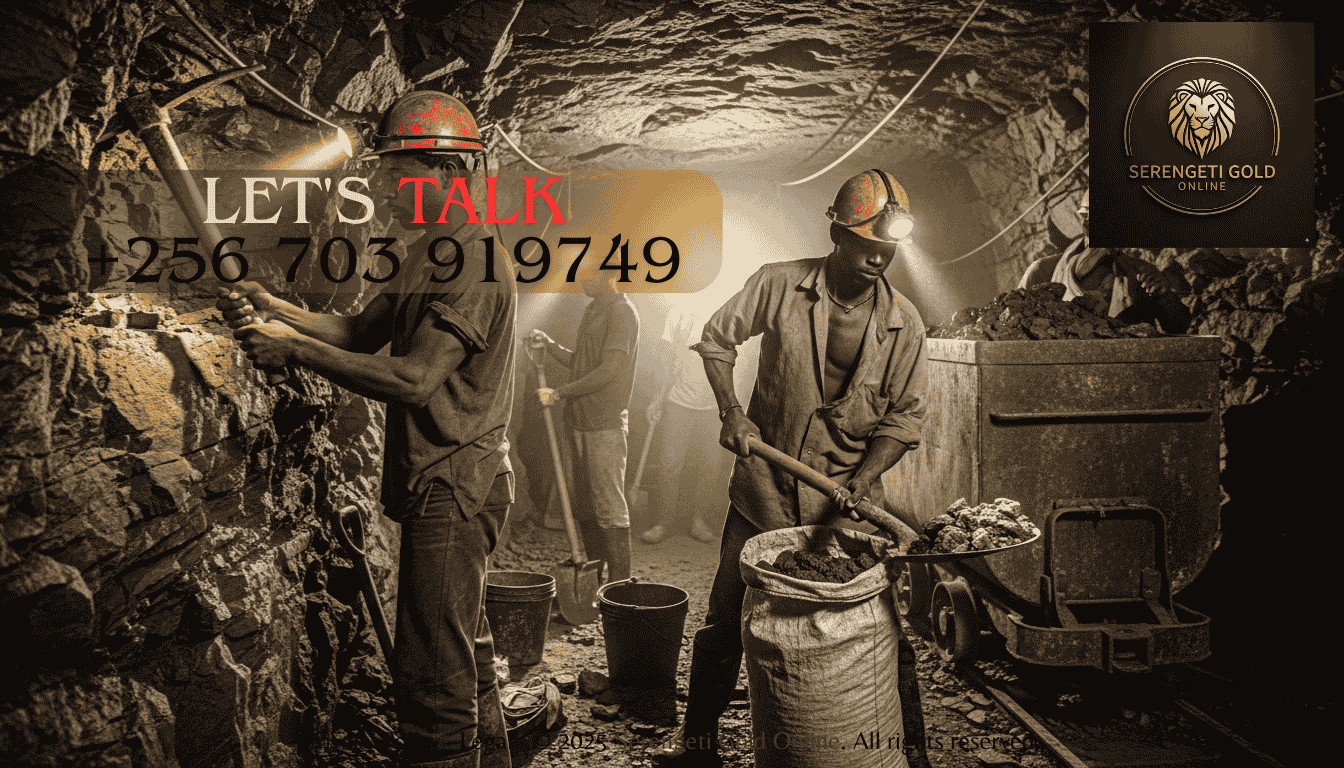
Behind every ounce of gold is human labor — and across Africa's gold mining sector, the conditions under which that labor takes place vary enormously, from well-regulated industrial operations to informal artisanal sites with far less oversight. Labor rights remain one of the most important, and most complex, issues in the industry.
Industrial mining operations, particularly those backed by major international companies, typically operate under formal labor codes, union agreements, and international standards. Artisanal and small-scale mining, by contrast, often operates outside formal labor protections entirely — not necessarily by choice, but because informality is often the default condition of an unregulated sector.
This gap is exactly why formalization efforts matter, as discussed in our piece on artisanal and small-scale mining: bringing ASM into formal frameworks tends to improve labor conditions alongside market access and safety.
Women make up a significant part of the mining workforce across many African countries, particularly in artisanal settings — often in processing and support roles, though increasingly in leadership and ownership positions as well. Their labor rights and working conditions are an important, and sometimes underrepresented, part of this broader conversation.
Buyers further down the supply chain have real influence over labor conditions at the point of extraction. Choosing to source from operations that uphold fair labor practices — and being willing to pay accordingly — creates market incentives for better conditions across the sector, rather than a race to the lowest cost regardless of human impact.
At Serengeti Gold Online, we prioritize partnerships with mining operations and communities that treat fair labor practices as non-negotiable, as part of our broader commitment to ethical sourcing across East Africa.
Continue exploring the series: see the physical risks tied to this issue in Risks & Dangers in Gold Mining, or the community dimension in Sustainable Mining Practices. Return to the Gold Mining & Extraction hub for the complete guide.
👉 Want to know more about the labor standards behind our sourcing? Contact Us or Chat on WhatsApp.
.png?width=1344&height=768&name=Large%20open-pit%20gold%20mine%20with%20heavy%20machinery%20and%20processing%20plants%20(1).png)